Should I Get A Divorce? Get the Facts Before You Decide!

Divorce Is Harmful for Everyone in the Family
Divorce is harmful to everyone in the family. However, accepting a bad marriage or committed relationship is also harmful. This is why it is best to fix relationship problems. Then you will WANT to stay with your partner and avoid divorce or separation. (Below you will be presented with many resources to fix a broken relationship.) As you read and learn more, you will understand how divorce is harmful to everyone in the family.
Only when there are problems such as drug abuse, infidelity, financial abuse, emotional abuse, or violence that cannot be stopped, should divorce be seen as a reasonable option. Even in circumstances such as these, knowing when to divorce needs to be considered.

Considerations such as the age of the children, the financial outcome of a divorce, and social support are all important factors when deciding when to get a divorce.
Should You Get a Divorce?
Many individuals wonder, “Should I Get a Divorce?” Before you decide to get a divorce, learn the facts so you will understand what happens to individuals when they divorce.
Before you decide whether or not you should get divorced or separate from your partner, educate yourself about the consequences of a committed relationship breakup.
If your wife wants a divorce or your husband wants a divorce, share this information with them.
Everyone who wants a divorce should know ‘the scientific facts’ before they take irreversible action to dissolve their relationship.
The following scientific facts about divorce, being alone, and remarriage are taken from, Journal of Marital and Family Therapy, July 2018, Volume 44, Issue 3, Pages 512-526.
Divorce and Physical Health
On average, single individuals have 20% more occurrences of heart disease, diabetes, or cancer, and are 23% more likely to have mobility problems. Interestingly, when remarried individuals are compared to individuals who have been continuously married, it was noted that the remarried individuals report significantly worse health.
Divorced individuals have a poorer prognosis for the diseases from which they suffer. Divorce is a health risk comparable to smoking, high blood pressure, obesity, and physical inactivity.
Divorce and Mental Health
Divorced individuals experience more anxiety, depression, and loneliness than do people cohabiting within a committed relationship. The period before a divorce, during the process of divorce, and until the divorce is finally implemented and all the extenuating legal issues resolved can take many years.
This divorce process can completely drain you emotionally due to fighting and accusations. It can drain you financially through spousal support, child support, therapy, assessments, and legal fees.
For most members of the family, these are years of stress, uncertainty, anger, and emotional pain. And often, some issues are never resolved in spite of time and effort and remain an ongoing source of pain and resentment.
For most unhappy couples, the goal should be to fix the relationship problems and stay together as a family, when doing so is reasonable and affords the greatest possibility of a positive outcome.
Living with Relationship Distress is Harmful Too!
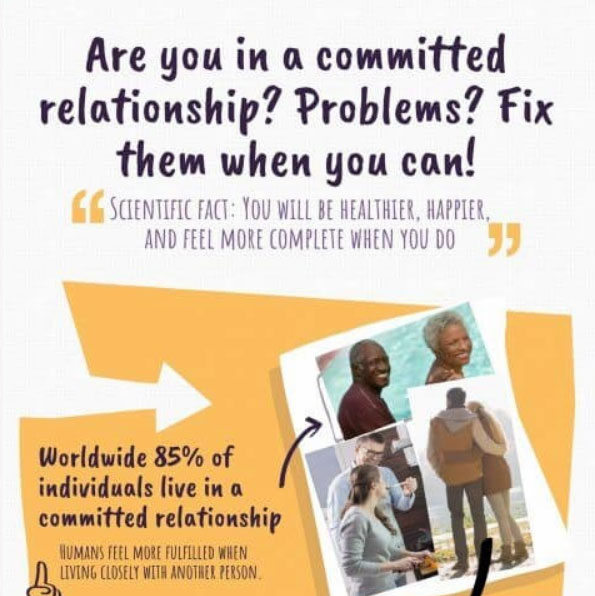
Divorce has Many Adverse Consequences, but Living with Relationship Distress is also Harmful. Worldwide statistics show that 85% of people enter into a committed relationship by the age of 50 regardless of culture, country, or religion.
Scientists suggest that being in a committed relationship is an evolutionary driven urge. Even though committed relationships are common, many couples experience relationship stress. In the United States, 31% of married couples characterize their relationship at any given time as stressed.
Typically, this relationship distress remains unless there is treatment to fix the specific problems. Researchers have found that committed relationship distress is a significant factor in poor physical and mental health.
Bad Relationshipa and Physical Health
Relationship distress can lead to poor physical health.
Researchers speculate that one of the reasons for this result is, that poor quality relationships may lead to risky health behaviors such as smoking, using drugs, using alcohol, poor eating, and inadequate sleep.
Relationship researchers drawing from a comprehensive meta-analytic review from 126 studies show that marital discord was predictive of chronic fatigue, lower immune functioning, ulcers, chronic pain, atherosclerosis, hypertension, cardiovascular disorders, diabetes, and rheumatoid arthritis.
The link between relationship distress and poor health is so strong that it has been identified as a greater risk factor for health problems than smoking or drinking alcohol.
One study found a significant association between committed relationship distress and increased hospital and doctor office visits. For these individuals, there was an increase in using medication.
A Bad Committed Relationship and Mental Health
Researchers have documented that relationship distress is associated with an increase in the utilization of mental health services.
Adults in distressed relationships were 70% more likely to seek mental health services than adults in non-distressed relationships.
In particular, those individuals in distressed relationships had a 40% more likelihood of experiencing anxiety, a mood disorder, or substance abuse disorder, than those individuals in happy relationships.
Infidelity and domestic violence, in particular, are significant predictors of major depression.
Relationship distress is predictive of a 69% greater likelihood of an anxiety disorder compared to happily married individuals.


When Possible, Most Broken Relationships Can and Should Be Fixed!
When there is marital or committed relationship distress, it should be every couple’s goal to avoid separation and divorce and protect their children from the clear and undisputed negative psychological effects of divorce on children.
If the relationship includes ‘relationship sins’ such as cheating or emotional abuse, the challenges to staying together will be much more difficult. However, it may be possible with effort and commitment to remain together.
People can change for the better.
Look around, and you will find many examples of individuals who have reformed their lives and become far better individuals than they had been in the past.
If you decide to stick with your partner because you have decided getting divorced is not a reasonable option, you should also conclude that living in a bad marriage or committed relationship is also not a reasonable option.
Living in relationship conflict and distress is extremely harmful and is not a reasonable alternative to divorce. Instead, the only sane thing to do is to repair your relationship.
You may not make your relationship perfect, but you can improve it and make it a far better option than either divorcing or living in a bad marriage or a bad committed relationship.