Emotional Abuse

Sometimes, emotional abuse is difficult to identify since it doesn’t leave physical marks the way physical abuse does. To know the signs of emotional abuse, you need to look at the behavioral patterns of the abuser.
Emotional abuse can present itself within relationships in many different ways. The most common manifestation of emotional abuse is through having relationship control and power over the victim of emotional abuse.
Control
Control is seized by the abuser through a mixture of criticism, explosions of anger, insults, neglectful behavior, and even threats once an emotional attachment with the victim has been established.
Being yelled at and criticized will make you question your abilities and sanity. Being neglected by someone you want attention and affection from leads to a lowered perception of your own sense of worth. Insults, even subtle ones, make you question your human right to self-determination. Threats add fear to this already emotionally toxic mixture.
Power
If the victim of emotional abuse does not understand their situation and doesn’t recognize that their partner is an emotional abuser, then he or she will come to believe that they cannot survive without their abuser.
All the threats, anger, neglect, and insults have taken their toll and the victim, whose self-esteem has been destroyed, believes they cannot survive on their own.
If the abuser threatens to leave, fear sets in, and the victim clings to their abuser even more and becomes even more compliant in an effort to prevent their emotional abuser from leaving.
At this point, the emotional abuser has seized full control of the relationship and has absolute power over his or her partner.
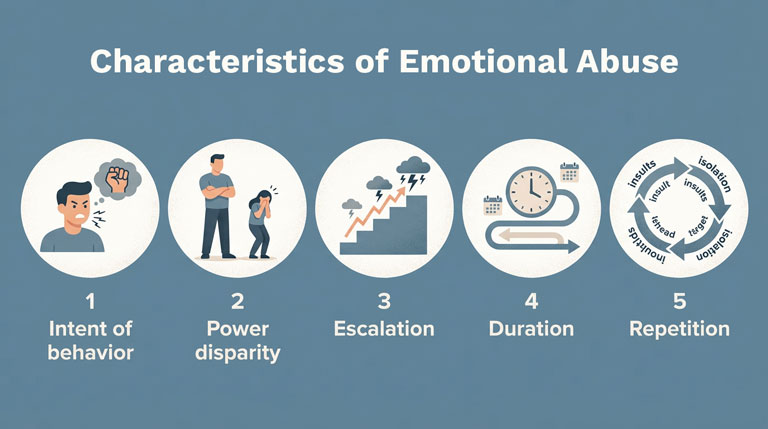
5 Characteristics of Emotional Abuse
Intent of Behavior
The emotional abuser intends to assert that he or she is superior to his or her partner and that this entitles him or her to the right to make decisions and control. The abuser’s systematic harsh criticisms of his or her partner are a clear sign that he or she is attempting to establish dominance.
He or she wants to establish the belief that their way is always right and that his or her partner is always wrong.
Power Disparity
Abusers establish power over their partners in two ways:
- Physical. Having more resources such as money, ownership of material goods, a larger body, a louder voice, or a gender advantage (such as being a man).
- Position. Having convinced his or her partner that because of his or her superiority, this then naturally leads to the conclusion that they should make all the decisions.
The abuser’s authority is expressed with an aggressive twisting of the victim’s thinking, insisting that it is a pathetic collection of absurdities (gaslighting). The abuser’s fight to have all the power is no different from that of a cult leader who brainwashes his or her subjects and then demands compliance.
Escalation
Typically, emotional abusers are willing to squash any challenges to their power and proceed with the belief that it is any means to an end. The abuser may take away their partner’s car keys or wallet, break personal belongings, or even resort to physical assault.
To an abuser, normal limitations do not apply. In their mind, they believe they are entitled to control and that nothing will ever get in their way of achieving whatever he or she desires.
Duration
Emotional abusers are comfortable making their partner uncomfortable. Due to this fact, they are prepared to sustain a fight as long as it takes to establish and maintain their superiority and control. At the time of conflict the arguing, threats, and cursing, may go on for hours. It may manifest as passive-aggressive anger or withdrawal for long periods. A person who inflicts emotional abuse may seek to punish his or her partner by refusing to engage in romantic and sexual activity.
Repetition
The emotionally abusive person knows that he or she must continually assert his or her dominance. Thus, the abuser asserts the same demands repeatedly without considering the needs of his or her partner or the current situation.
Should the victim assert his or her right to be free or independent, the response of the abuser is predictable. He or she will repeat his or her efforts to assert control and not let up until he or she has conquered any resistance.
Types of Emotional Abuse
Emotional abuse comes in many forms, including psychological, mental, financial, spiritual, and sexual.
Emotional Abuse, Psychological Abuse and Mental Abuse
- Your abuser makes you think that your thoughts and ideas are wrong. This includes gaslighting, in which even your sanity is in question.
- Aggressive forms of emotional abuse include name-calling, public embarrassment, bullying, and isolation from family and friends.
- Most emotional abusers use anger to instill fear in their victims.
| Abuse Type | Main Target | What It Attacks | Main Outcome |
|---|---|---|---|
| Emotional Abuse | Feelings | Self-worth, emotions | Low confidence, shame |
| Psychological Abuse | Thinking | Reality, perception | Confusion, self-doubt |
| Mental Abuse | Mental health | Long-term well-being | Anxiety, depression, trauma |
Verbal Abuse
Verbal abuse involves the repeated use of insults, threats, ridicule, and harsh criticism to wear down your confidence and sense of self. Over time, these hurtful words weaken your ability to stand up for yourself and resist control. The goal is not communication, but domination through fear, shame, and emotional pain. Healthy words build up and protect dignity, abusive words are meant to destroy it.
Financial Abuse
Financial abuse occurs when a partner controls, withholds, or restricts access to money you are rightfully entitled to, whether you earned it or share legal responsibility for it. It may include making major financial decisions without your input, hiding information, or limiting your access to accounts. It can also involve preventing you from working, sabotaging your employment, or discouraging financial independence. This form of abuse is meant to create dependence and take away your freedom of choice and security.
Spiritual Abuse
A spiritually abusive partner may misuse scripture, religious teachings, or their position in a faith community to control, shame, or silence you. They twist spiritual beliefs to make you doubt your worth, your choices, or your right to set boundaries. This form of abuse hides behind “faith” while violating trust and conscience. True spirituality honors dignity, freedom, and respect, not domination.
Sexual Abuse
An abusive partner may try to control you by forcing sexual activity or by withholding intimacy as a form of punishment or manipulation. In both cases, sex is being used as a tool for power rather than love or connection. This behavior is wrong and harmful, regardless of how it appears on the surface. Every person has a God-given and human right to live with dignity, freedom, and without being controlled by another.
Emotional Abuse Quiz
1+ Million People have already taken the scientific-based Emotional Abuse Test!
Take our emotional abuse test to learn if you are suffering from emotional abuse.